Almost every OEM inquiry starts the same way. Can you change this?
Some changes cost nothing. Some cost tooling and a longer lead time. A few should be refused outright, because they are the reason the product holds up.
Bags and hard cases answer those questions differently, so this covers both.
Quick answer
– Soft bags. Start inside. Divider positions, removable pouches, tray count.
– Hard cases. The shell is a mould. Start at the dividers, tray depth, hardware and branding.
– Either way. Anything that changes weight, stiffness or closure gets sampled, not approved from a drawing.
We have built beauty storage since 2000, mostly for brands that come back with a second and third order. That is the only reason this guide can be specific.
1. Structure and interior layout
The interior is where a sample earns its cost.
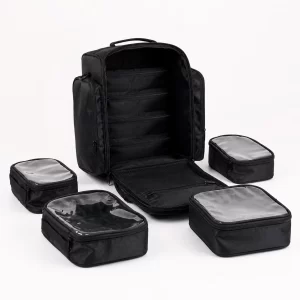
Soft bags. The reference 3329 organizer bag with four removable pouches is a 35 × 27 × 33 cm body with two large and two small pouches, each with a clear PVC top. Pouch count, proportions and how they sit inside the bag are open to discussion. What is not open is the relationship between pouch size and bag size. Grow the pouches and the usable height for bottles drops.
Hard cases. The shell is a mould, so what changes is inside. Divider set, tray depth, number of trays. Two shallow drawers and one deep drawer is a different product from three drawers of equal depth. A deep drawer holds bottles upright. Two shallow drawers hold palettes and nothing taller than a compact.
Ask for the internal dimensions of each compartment. The external size only tells you what the case looks like in a photograph.
2. Materials
The material list is shorter than most buyers expect. Each option solves one problem and creates another.
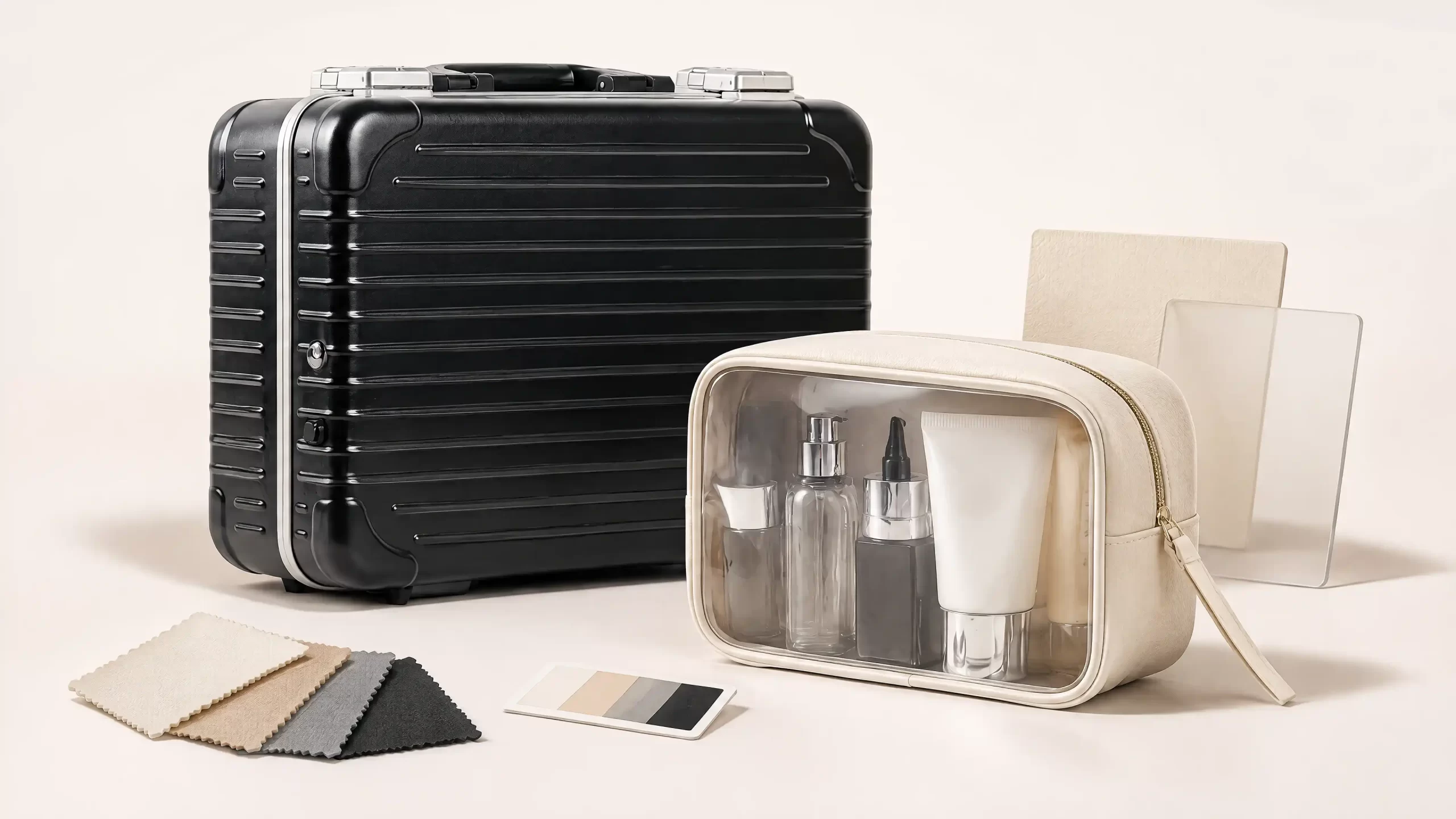
– PU leather wipes clean, and shows creases where the bag folds
– Oxford fabric, commonly 1680D, takes abrasion and stays light
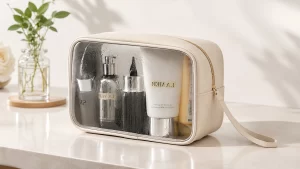
– TPU and clear PVC panels make the contents visible, and stiffen the panel
– Aluminium, ABS, PC and HPL board on hard cases, chosen by weight, rigidity and fire behaviour
Moving a bag from Oxford to PU changes weight, stiffness, how the seams behave and how it folds. That is why a material change gets sampled. If you are weighing those trade-offs, the PU, Oxford and clear PVC comparison covers how each behaves in daily use.
3. Hardware and closure
Zippers, pulls, buckles, rivets, handles and locks are touched most often, and fail first.
On soft bags, the zipper rarely fails before the pull does. The wear sits where the pull joins the tape, and a branded pull that looks better in a photo can be the first thing to go. Ask what the pull is attached to, not just what it looks like.
On hard cases the locking system is a specification. The AL-3828 workstation carries a keyed metal lock plus a settable combination lock. The combination lock mainly secures the tabletop in the folded position so it does not open in transit. A different arrangement is a hardware decision that has to be reviewed with the shell, not after it.
4. Branding
There are three routes, and they are not interchangeable.
| Method | What it looks like | Watch for |
|---|---|---|
| Print on fabric | Flat, part of the surface | Ink behaves differently on PU and Oxford |
| Metal plate, riveted | Rigid, distinct from the fabric | Plate sits flat; rivet backs must not intrude into the lining |
| Embossed or debossed detail | Subtle, texture-based | Needs enough material thickness to hold the shape |
Rivet placement is the part buyers underestimate. A rivet back that presses into the lining looks fine on a flat sample. It shows up as a mark on the inside of the bag after the first trip, once the bag has been packed, carried and repacked. Put a loaded sample on the table and look inside before approving the plate.
The riveted aluminium plate on the 3329 customization reference went through that check: plate material, dimensions, artwork, position and rivet placement, all confirmed on a sample before production. None of it was decided from a drawing.
5. What a customization change does to MOQ and lead time
Some changes absorb into a normal run. Others create new work.
Absorbed. A colour already in the range. A logo applied with an approved method. A divider set moved to a position that is already tooled.
New work. A new shell mould. A new pouch pattern. A new plate die. These are quoted separately, because they carry tooling and a first-article check, and they add production time on top of the standard run.
As a working reference across the range, 100 units for rolling and trolley formats, nail tables and chairs, and 500 units for most soft bag styles. Sampling runs about 10 to 15 days. Bulk production runs about 25 to 40 days after details are confirmed. Treat those as the opening position for a quote. How MOQ, sampling and customization get priced on a comparable specification is covered in the OEM buying guide for vanity cases.
6. Lighting, if the product has one
Add a light and you add a battery, a charging port, a control method and, in most markets, a compliance question.
The specification that matters is short. Colour temperatures, stepped or stepless brightness, battery capacity, connector. A 2500 mAh battery charged over USB-C and a unit running on 110/220 V mains are different products with different certification paths. The first suits mobile work. The second suits a fixed station.
If the project targets the US market, confirm which configuration is being certified and what documentation the buyer needs. A test reference is not a certificate.
7. Packaging and acceptance
Packaging gets specified last and delays shipments first.
Decide early whether the unit ships in a plain poly bag, a printed inner box or a retail-ready carton. Confirm carton marks, barcode format and the pallet pattern your warehouse actually uses. On quality, agree the acceptance criteria before production starts. What is checked, on how many units, and what counts as a defect. The sample approval checklist covers the checks to write into that agreement.
8. What to send with the inquiry
Six things shorten the loop more than anything else.
1. What the product has to carry, with the dimensions of the largest item
2. Where it will be used, and how it will be moved
3. Which changes you actually need, ranked
4. The target market, because it decides plug type and compliance
5. Quantity for the first order, and an annual estimate
6. Any artwork, even a rough file
With those six, a supplier can say what is a sample change and what is a tooling change before anyone spends money on either.
FAQ
Which parts of an OEM makeup bag are usually customized first?
The interior layout. Divider positions, removable pouches and tray count change how the bag works day to day. The outer material mostly changes how it looks and how it wipes clean.
Can the shell of a hard case be changed?
Only by making a new mould, which is tooling work rather than a customization option. Dividers, tray depth, hardware and branding change without a new shell.
Does a logo change the MOQ?
Not if the logo uses an approved method on an existing product. A new plate die or a new printing setup is tooling work, quoted separately.
What is the standard MOQ?
100 units for rolling and trolley formats, nail tables and chairs. 500 units for most soft bag styles. Lower volumes are possible when an existing mould and stock materials are used.
How long do sampling and production take?
Sampling is about 10 to 15 days after artwork and specification are confirmed. Bulk production is about 25 to 40 days, plus any time for new tooling.
If you are still choosing between suppliers rather than between configurations, how to vet a manufacturer before ordering covers the checks worth running first.
The short version
Layout first. Material second. Branding third.
Ask for internal dimensions. Sample anything that changes weight, stiffness or closure. And separate a configuration change from a new part, because only one of them needs a new mould.
If you are still choosing the format itself, the comparison of whether the kit needs a wash bag or a makeup case is the decision that comes before this one. The two ranges are here: makeup bags and makeup boxes.