A wash bag fails in the same three places every time: the zipper tape, the seam where the base meets the side wall, and the corners. None of them are visible in a product photograph, and none of them appear in a spec sheet unless the buyer asks for them by name.
“Water-resistant” on a listing tells you almost nothing about what happens when a bottle of toner opens inside the bag at 30,000 feet.
First, the words
Two terms get used interchangeably and should not be.
Water-resistant means the material slows water down. A splash beads up and can be wiped off. A pool left overnight will eventually find a way through a seam or a zipper.
Waterproof means the construction resists water entry under a stated condition — a hydrostatic head, a submersion depth, a duration.
Our own wash bag specifications say water-resistant, not waterproof, and that is deliberate. A soft bag with a stitched, unsealed zipper cannot honestly claim waterproof — dry bags achieve it with welded seams and a roll-top closure, which is a different construction. A supplier who claims waterproof without a test number is telling you they have not thought about it.
If a brand needs a genuinely waterproof interior, the answer is usually a removable TPU pouch with a welded seam, not a coating on the outer fabric.
Where a leak actually starts
The zipper. The teeth do not seal. Water passes between them, and the tape that holds them is stitched, so the stitch holes are holes. A standard coil or metal zipper on a wash bag is a path, not a barrier. Water-resistant zippers exist: coated coil, or a flap behind the zip. They cost more and feel stiffer.
The seam at the base. A stitched seam is perforated by construction. On a lined bag, the lining is stitched too, so there are two rows of holes roughly aligned. Hold the seam up to a lamp with the bag turned inside out: the perforations show as a line of pinpricks.
The corners and the gusset fold. These are where the fabric is compressed, where coating stretches thinnest, and where a folded base traps liquid against the material with nowhere to drain.
The lining itself. A bag lined in a woven fabric wicks. A bag lined in a wipe-clean film does not. This matters more than the outer material, because the inside is where the spill happens.
What changes in the specification
Once you decide the bag has to hold liquids rather than just carry them, five things change.
The lining becomes a material decision, not a colour decision. TPU film, PVC sheet or a coated polyester: each has a different feel, a different fold memory and a different reaction to alcohol-based products. The requirement is that it stays continuous, wipes clean, and is sealed or folded at the seams rather than left raw.
The zipper gets specified by function. Single-way or two-way, metal or coil, standard or water-resistant, and whether there is a storm flap behind it. On our
1611 three-piece set, all three sizes use a single-way metal zipper; on the
HZB-3, the three sections each close independently, which limits how far a spill can travel.
Interior layout changes the risk. A single open compartment means one leaking bottle wets everything. Separate zippered sections — as on the
HZB-2, which splits a lid mesh pocket from a transparent TPU compartment — contain the damage to one zone.
The transparent panel is a compliance feature, not a design one. Most markets cap liquids at 100 ml per container and require them in a clear bag at security. The exact thresholds, and how strictly they are applied, vary by country, and several airports have changed their rules in the last two years. Check the regulation for the market you are selling into rather than working from a general figure.
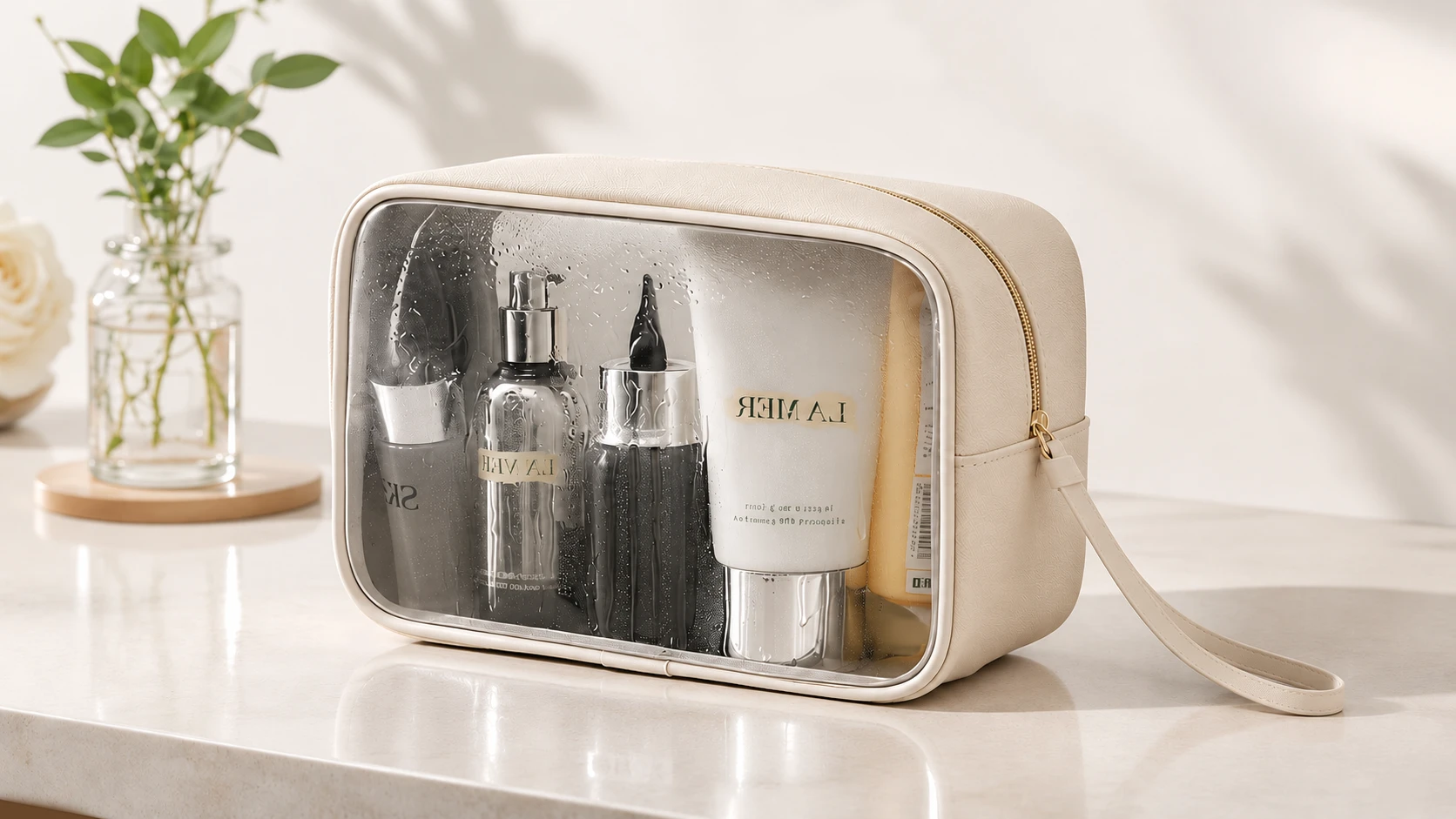
A TPU or PVC window lets the contents be seen without opening the bag. That is why clear panels appear on travel pieces and rarely on salon ones.
The base and the handle decide how it is carried. A flat, wide base stands up on a hotel shelf; a narrow one tips. A sewn side handle carries flat against the body; a top handle hangs from a hook. Neither is better, but a bag that gets carried wet needs a handle that does not wick.
Five minutes of testing on a sample
You do not need a lab to find out whether a wash bag will embarrass you in the first month. Four checks, five minutes, one sample.
The tissue test. Line the bag with dry tissue, close it, and run it under a tap for ten seconds on the outside. Open it. Any damp patch tells you where the water entered — usually the zip or the base seam.
The zip test. Pour a tablespoon of water inside, close the bag, lay it flat for a minute, then tip it so the water sits against the zip from the inside. Nothing should track along the tape and out.
The drop test. Put a filled, closed 100 ml bottle inside and drop the bag from waist height onto a hard floor, four times, rotating. Then check the bottle and the bag interior. This is where a thin lining tears at the corner.
The wipe test. Spill a little foundation or oil-based product on the lining, leave it ten minutes, then wipe with a dry tissue. Anything that stains or pills will look like that after a year of use.
If a sample fails the first two, no amount of specification writing will fix it — the construction is wrong.
What to put in the RFQ
Five lines are enough to get comparable quotes:
- Interior lining material and whether seams are sealed, bound or raw
- Zipper type, direction, and whether a storm flap is required
- Interior layout: single compartment, or separated zones with independent zips
- Whether a transparent panel is required, and which material
- The test the bag must pass, stated in your own words — for example, “no water ingress after ten seconds under a running tap”
That fifth line is the one most buyers leave out, and it is the only one that changes what the factory does.
Where we sit
Our wash bags are specified as water-resistant, and we say so on the product page rather than in the marketing copy. The HZB is a single-compartment PU pouch; the HZB-2 and HZB-3 add transparent TPU zones and separated sections; the 1611 set uses clear PVC panels on both faces.
All four carry a minimum of 500 pieces, with sampling around 15 days and bulk production 25 to 35 days after the sample is approved.
They are built for the job most wash bags actually do: carrying closed containers between places. If your product has to survive a genuinely hostile condition, such as a checked bag, a wet counter or a bottle that opens in transit, that requirement has to be designed in at the sample stage rather than inferred from a listing.
If you are still deciding between a wash bag and a makeup case for the same kit, that comparison is a separate question and we wrote it up here. If you have settled on a wash bag and are moving to sampling, the sample approval checklist turns each of the five RFQ lines into something you can physically check.