Most OEM wash bag briefs start with a product name, not a question. Someone asks for a wash bag, someone else asks for a makeup case, and the factory quotes whichever wording arrived first. Then the sample comes back and the real problem appears: the kit does not fit the format.
The format is decided by what the kit carries, not by what the buyer called it in the first email.
Start with what is inside the kit
Split the contents into three groups and the format usually selects itself.
Liquids and gels: shampoo, toner, cleanser, hand sanitiser, wet brushes. These need a surface that wipes clean, a closure that does not seep, and a way to keep bottles from pressing against each other. If the bag is being designed around that list rather than simply carrying it, what changes when a wash bag has to hold liquids covers the construction decisions.
Powders and palettes: eyeshadow, blush, compacts, loose powder. These need flat space and dividers that stop hard edges from knocking together.
Tools: brushes, pencils, tweezers, spatulas, small electricals. These need length, and often need to be separated from anything that marks fabric.
A kit that is mostly liquids points to a wash bag. A kit that is mostly powders points to a makeup case. A kit that is both, which is common for travelling artists and for hotel amenity programmes, needs a case that can do both without pretending to be two products.
The flat, windowed case
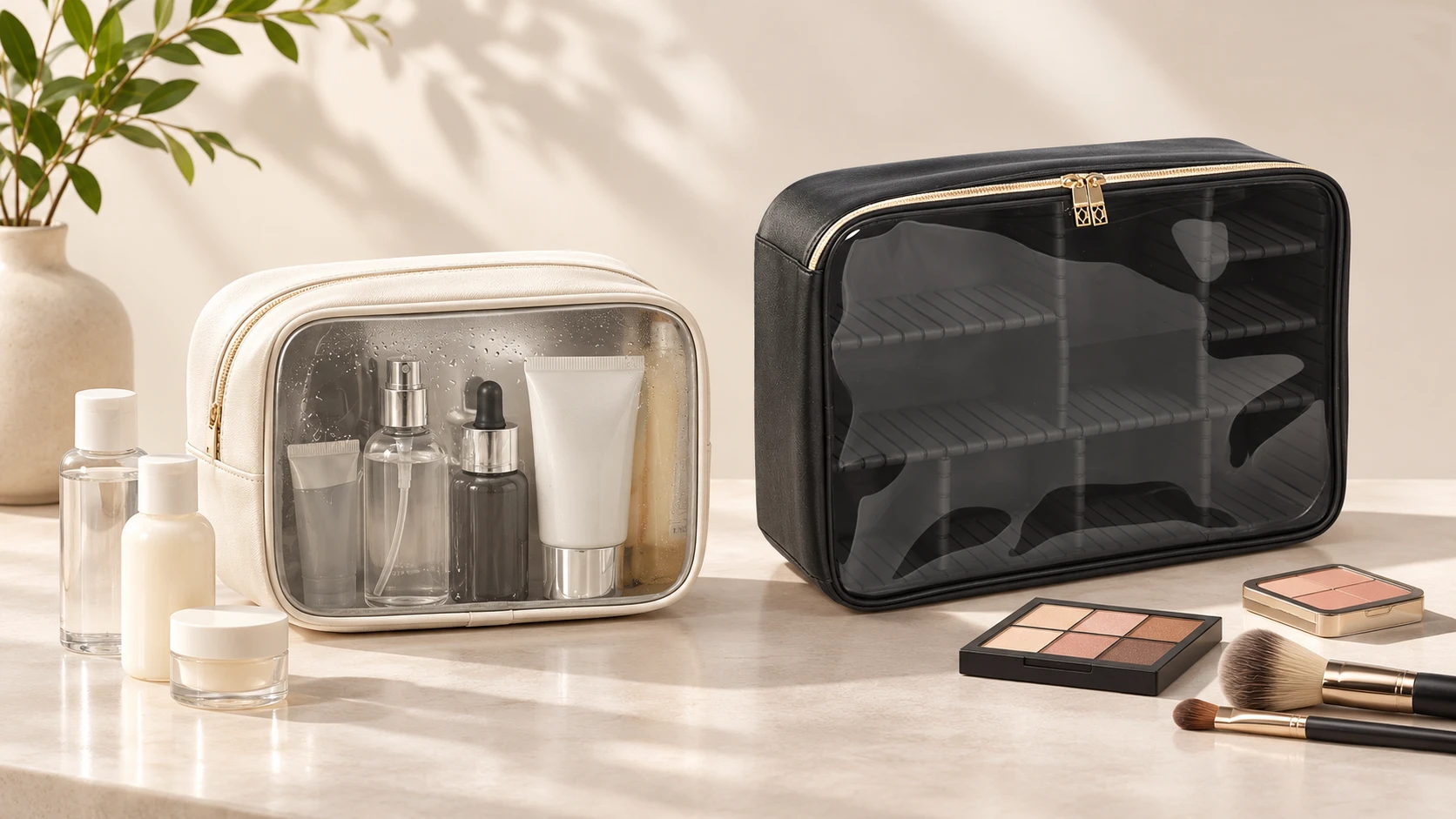
A flat case such as the DB16 sits between a wash bag and a makeup case. The body is high-density Oxford fabric with a frosted transparent PVC front panel, and the interior measures 385 × 110 × 270 mm with the dividers removed.
Three things make it useful for mixed kits.
The lid opens fully flat. Everything is visible at once, on a bathroom counter or a dressing table, instead of being dug out of a deep bag.
The front panel is transparent, so the contents can be checked without opening the case. For a working artist that is a two-second check before leaving. For a brand packing kits, it is a way to see what is missing before the box is sealed.
The shell is water-resistant laminated fabric with a water-resistant zipper. Splashes and rain stay outside. It is not rated for submersion, and bottles should still be checked for leaks before travel.
The dividers are EVA foam, 1 cm thick, and they drop into slots in the base rather than being fixed with tape. One long divider splits the case into two zones, four medium dividers create bays for palettes and compacts, and five small dividers separate lipsticks, pencils and brushes. All ten lift out, so the same case can be a divided organizer in storage and an open tray while a kit is being built.
Bottles travel lying flat inside the 385 × 270 mm area. That is how a 200 ml shampoo fits: not standing up through 110 mm of depth, but lying down across the width. Only items thicker than 110 mm will stop the lid closing.
The rolling case
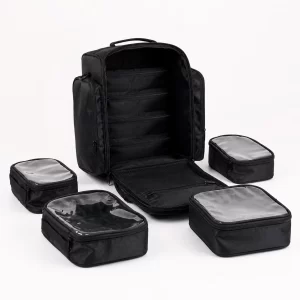
When the kit has to move between rooms, floors or venues, wheels matter more than a flat opening. A rolling case with removable dividers, such as the 4221, carries weight, keeps the kit upright while moving, and can be opened where it stands.
The trade-off is weight and packing volume. A rolling case with a frame and casters weighs several times what a flat case does, and it cannot be folded into a suitcase. If the kit travels by car and gets unpacked on site, the wheels earn their cost. If it travels inside luggage, they do not.
The hard shell
Hard shells are the right answer for fragile contents and for anything where the case has to protect against impact rather than organize against movement. A hard shell case with a fitted mirror, such as the 4029 adds a rigid body and, in most versions, a lighting system.
That protection has a cost: hard shells are heavier, they do not compress, and the interior is fixed by the shell rather than by a slot pattern. Choose them when the contents are breakable, not simply when the buyer wants the kit to look premium.
Water resistance: what the words mean
Three phrases get used interchangeably in sourcing conversations. They are not the same.
Water-resistant means the material slows water down. A splash can be wiped off.
Water-resistant with a water-resistant zipper, which is what a laminated shell with a sealed zip gives you, means splashes and rain stay outside during normal handling. It does not mean the case survives being soaked or left in standing water.
For material comparisons behind these claims, see our PU vs. PVC vs. Oxford fabric guide.
Waterproof, in the sense buyers usually mean it, needs a test result: an IP rating, a submersion test, a documented procedure. Without that, a factory claim of waterproof is a marketing word.
For a wash bag or a bathroom pouch, the practical requirement is the second level. For a kit that will sit on a wet counter every day, that is enough. For a kit that will be dropped in a puddle, it is not.
What to confirm before sampling
Four points settle most of the back-and-forth.
Divider count and slot pattern. Ask how many dividers are standard, their thickness, and whether the slots allow repositioning or only removal.
Logo area by zone. Fabric, a transparent panel and a metal zipper puller take different decoration methods and different durability risks. Ask which methods the factory recommends for each zone rather than requesting one method across all three.
Carton data. Pieces per carton, carton dimensions and gross weight per carton decide freight. A page that only states unit weight cannot be used for a quote.
Water resistance wording. Ask for the exact phrase the factory will stand behind, and whether any test report exists.
Choosing between them
If the kit is mostly liquids and travels inside luggage, take the flat wash bag format. If it is mostly powders and stays on a counter, take a flat makeup case with dividers. If it has to move under its own wheels, take the rolling case. If the contents are fragile, take the hard shell.
If you are still comparing individual styles rather than formats, browse makeup bags before settling on a construction.
The mistake is buying the format that matches the buyer’s vocabulary instead of the kit’s contents. That mistake shows up in the first sample, and it is expensive to correct later.