Most makeup bag enquiries arrive with three words in them: dividers, brush compartment, double zip. They sound like decoration. They are not. Each one changes the pattern, the lining, the hardware and the packing method, and each one has a failure mode that only shows up after a few hundred units.
This is what those three features actually mean when they are specified for production, using formats we build regularly as reference points.
Dividers are three different things
The word covers at least three constructions, and they do not cost the same.
| Type | What it is | Where it wins | Failure mode |
|---|---|---|---|
| Fixed dividers | Stitched or glued into the body | Known kit, lowest cost | Cannot change after sampling |
| Removable pouches | Separate zipped bags inside a shell | Users who repack and carry units | Pouch formats not mapped to positions |
| EVA or foam slots | Cut inserts wrapped in fabric | Rigid and mirrored items | Heavier, higher unit cost |
Fixed dividers are stitched or glued into the bag body. They are the cheapest option and the least flexible: the compartments are set at sampling and cannot move afterwards. They suit a bag built around one known kit, such as a lash or nail set where every item has a fixed place.
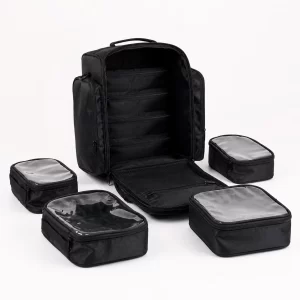
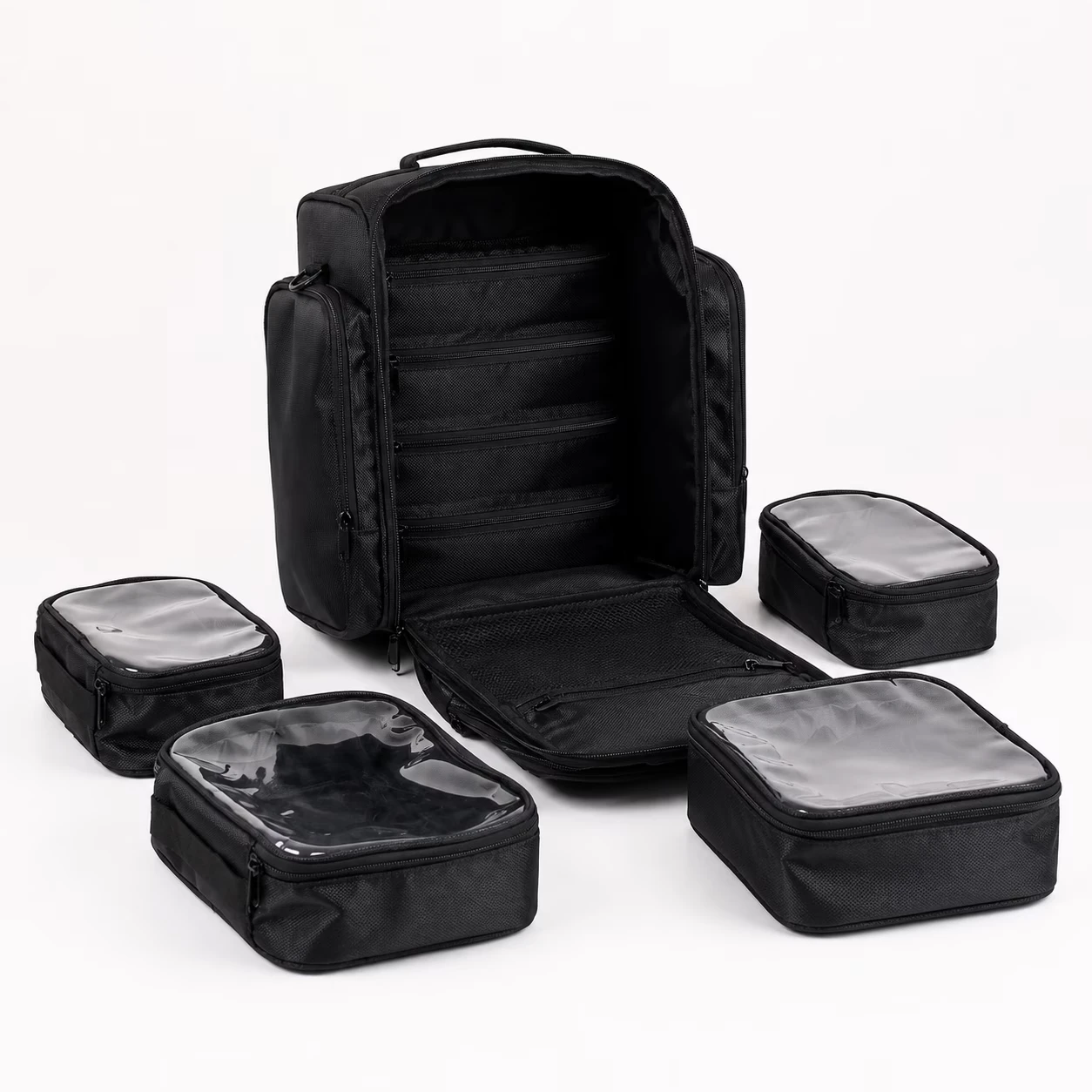
Removable pouches are separate zipped bags that sit inside a larger shell. The shell becomes a carrier; the pouches become the working units. Our 1680D Oxford organizer bag (model 3329) uses four PVC-top pouches — two large at roughly 23.5 × 19 × 8.5 cm and two small at roughly 19 × 13 × 8.5 cm — inside a soft-sided body of about 35 × 27 × 33 cm. The bag weighs around 1.1 kg empty. That weight matters: a pouch system adds fabric and zips, and the buyer notices it on a shelf.
EVA or foam slots are cut inserts, usually wrapped in fabric, that hold rigid items. They protect better than pouches, cost more per unit, and they are the option that reliably keeps glass or mirrored items from knocking together.
The specification question that decides between them is not which is better, but whether the user repacks the kit or carries it as loaded. If they repack, use pouches. If they carry as loaded, use slots.
One detail causes rework more than any other: pouch size-to-format mapping. Our 4228 rolling bag holds five removable pouches in a body of 40 × 21 × 38 cm, and the confirmed pouch formats are 26 × 16 × 7 cm and 16 × 14 × 7 cm. Writing “five pouches” in an RFQ is not a specification. Writing which pouch format goes in which position is.
Brush compartments are a length problem before they are a layout problem
A brush compartment usually fails for one reason: the longest brush does not fit, or it fits only diagonally and bends the bristles. In UK and EU enquiries the same product is often written as a make-up brush organiser, so expect both spellings on the same brief.
Three numbers decide it: the length of the longest brush, the height of the compartment wall, and whether the flap closes over the bristles or beside them. A compartment that closes over the bristles protects them and needs another 15–20 mm of depth. A compartment that closes beside them is slimmer and lets dust in.
The BS-1 folding brush bag is built the second way, with a soft PVC flap that folds into an upright holder so the brushes stand on a table between jobs. That is a different product from a bag with a brush pocket sewn into the lid, and the two should not be quoted against each other.
For nylon and Oxford bodies, the lining of the brush compartment is worth specifying separately. PVC wipes clean and resists powder; plain polyester does not. If the buyer has not asked, ask them — it is usually the cheapest upgrade in the bag and the one most often left out.
Double zip is about access, not strength
A double zip means two sliders on one track, opening from the centre outward. It is specified when the user opens the bag while it hangs, because a single slider forces the whole lid to one side and the contents shift.
What to put in the RFQ:
- Zip size and type — a #5 nylon coil is the common choice for soft bags; #8 or #10 belongs on rolling cases and heavy loads.
- Slider brand or grade — unbranded sliders are a frequent source of warranty claims, and the grade is worth naming on the sample file.
- Whether the two sliders meet in the middle or park at one end.
- Puller shape — a cord puller is quieter and cheaper; a metal puller reads as premium and snags in transit.
A double zip adds one slider and a short run of tape. It is not a second closure, and the cost difference is smaller than most buyers assume.
Nylon, Oxford, and the word waterproof
Most enquiries say “nylon” and most production runs use Oxford. The difference that matters is denier and coating.
1680D Oxford is a heavy, dense weave used on organizer bags and rolling cases. 600D is lighter and common on pouches and travel bags. Both are usually PU-coated, on the back of the fabric or occasionally on the face. The coating is what resists a spill; the weave is what resists abrasion.
Be careful with the word waterproof. A PU-coated Oxford bag is water-resistant and splash-resistant. It is not waterproof once water sits on a seam or works through a zip. Writing “waterproof” into a specification creates a claim the sample will not support, and it is the kind of line that comes back in a dispute. Write “water-resistant, not submersible” and the expectation matches the product.
What should be in the RFQ?
Six lines cover most of what a factory needs before quoting:
- Bag format and outer dimensions, with tolerance.
- Interior system: fixed dividers, removable pouches with formats and positions, or EVA slots.
- Brush compartment: longest brush length, wall height, flap direction, lining material.
- Zip: size, type, slider grade, single or double.
- Material and coating, plus the exact wording for water resistance.
- Target quantity and market, because certification and packaging follow from them.
Anything missing from those six comes back as a question, and a question round costs a week.
Where the cost actually moves
Dividers and a double zip are not the expensive decisions. Cost moves with pouch count, lining material, slider grade and packing method — four choices made in the RFQ, not at the factory gate.
Our standard MOQ across the bag range is 500 units, with sampling at about 15 days and bulk production at 25 to 35 days after sample approval. The timing depends on material, hardware and packaging. The removable pouch design guide covers how those dates are set on a pouch-based bag, and the customization options overview covers what else can change without a new pattern.
Where to go next
- Compare the two pouch-based formats: the 3329 1680D Oxford organizer bag and the 4228 modular rolling bag.
- See how a brush compartment is built around brush length in the BS-1 folding brush bag.
- Check material and coating choices in the makeup bag materials guide.
- Before approving a sample, run through the sample approval checklist.
- See the full range on the makeup bags category page.
- See the difference a shell makes: hard-shell vs soft-sided makeup case.
If the six lines above are already written, send them with your target quantity through the contact form and we will come back with a configuration, MOQ and lead time.
Need a Bag Built Around Dividers or a Brush Compartment?
Send the six lines from the RFQ section with your target quantity and market. We will come back with a configuration, MOQ and lead time. Contact our team with the spec you already have, even if it is only half written.