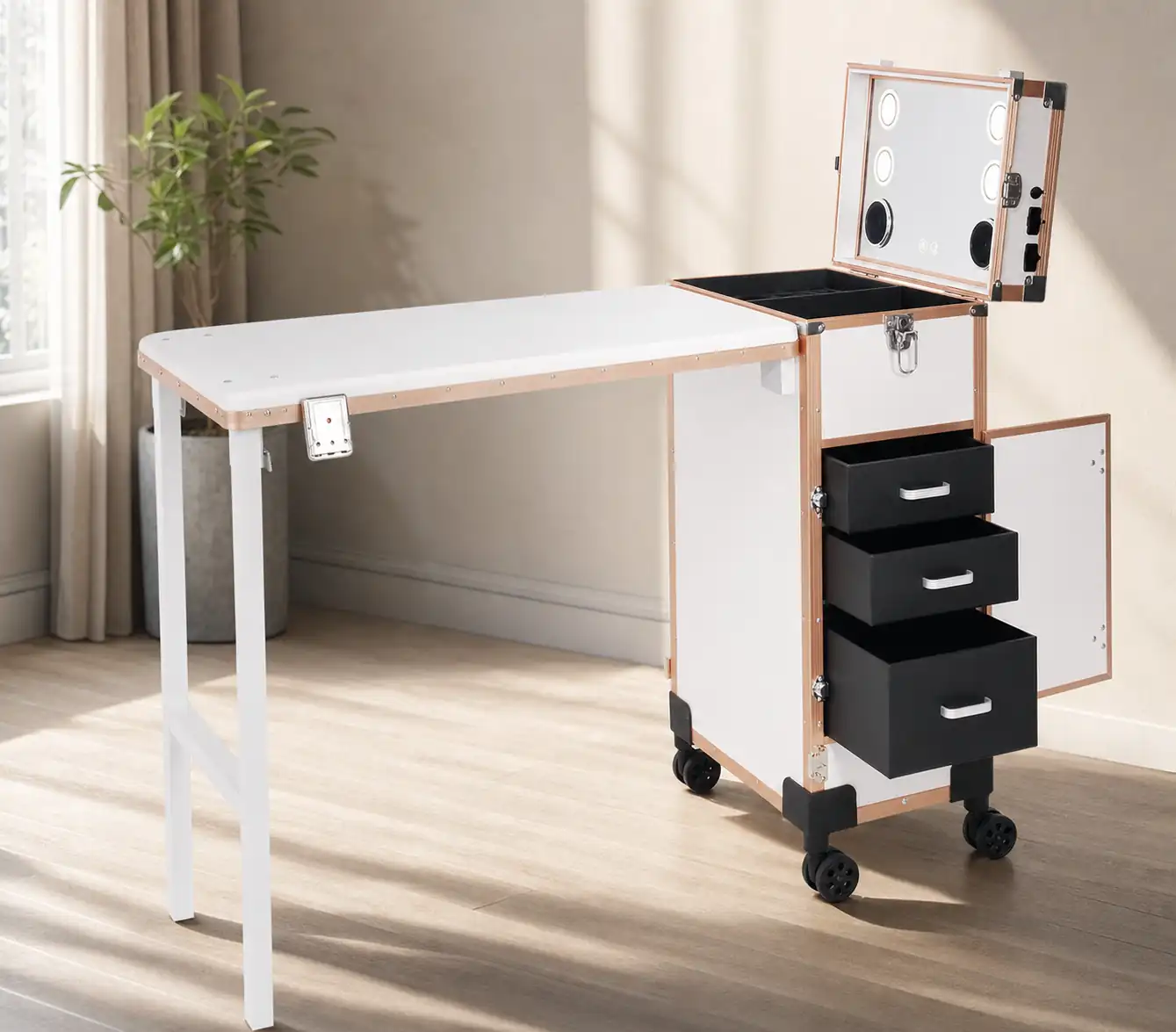
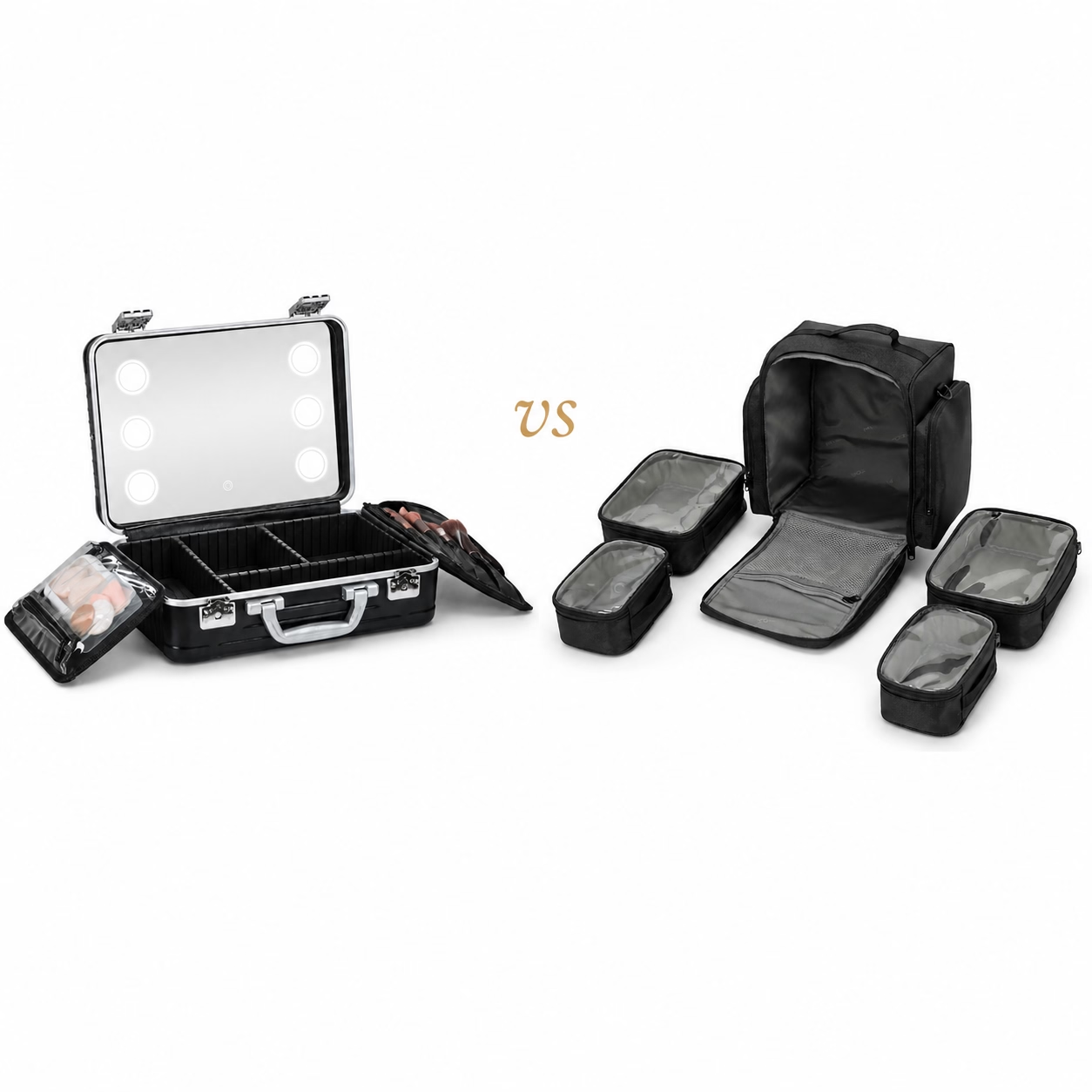
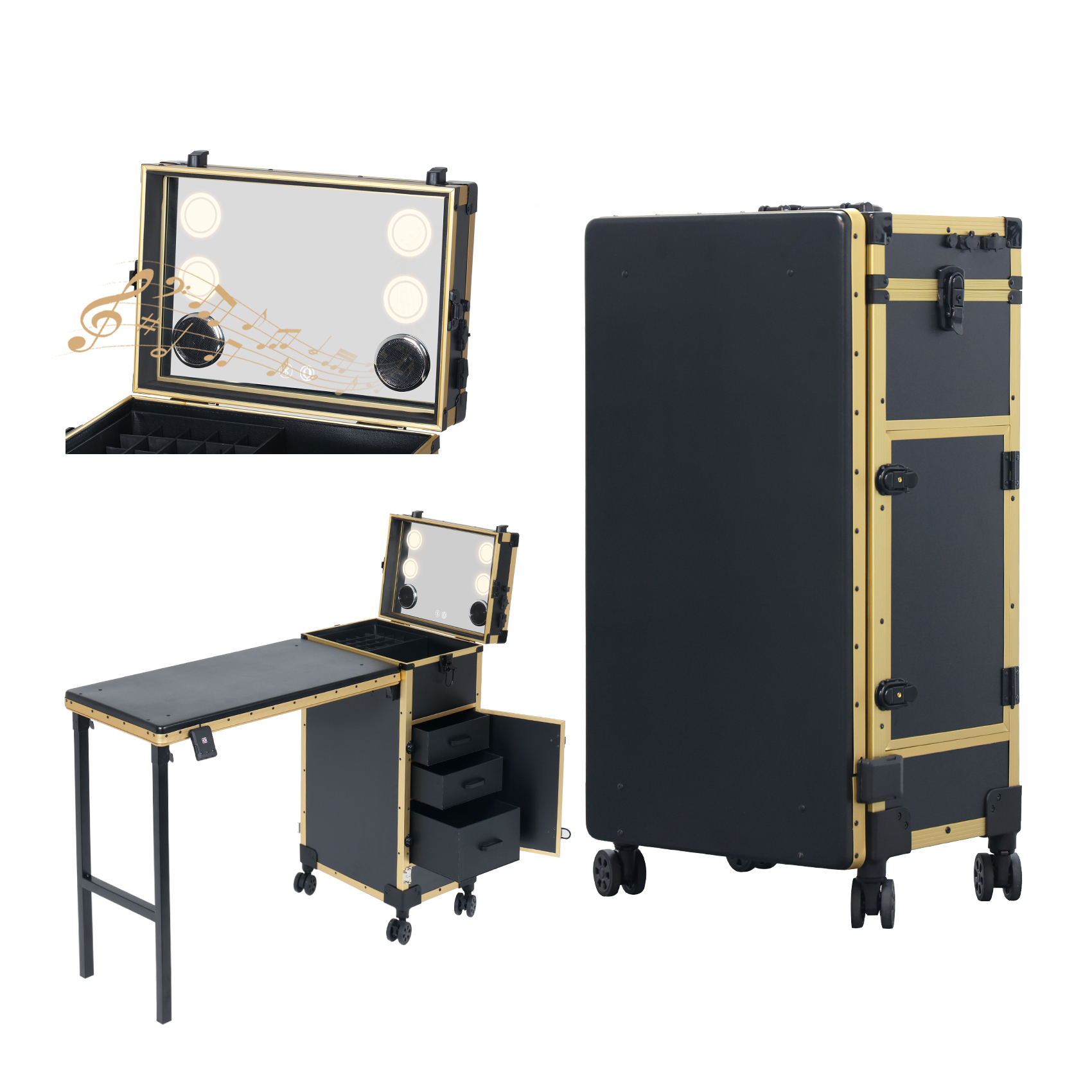
 A rolling manicure table has to move well, stay steady, and hold up under daily use. If the structure is weak, the table will feel unstable fast.
AL3829 uses an aluminum alloy frame, HPL fire-retardant panels on all surfaces, and aluminum alloy sheet storage boxes. That setup is meant to keep the table solid, practical, and easy to use in real salon work.
For buyers comparing different rolling manicure workstation structures, you can find a full overview of materials, features, OEM/ODM options and supplier guidance in our Rolling Portable Manicure Table Hub: Features, Materials, OEM/ODM and Supplier Guide.
Why the material matters
For a mobile beauty workstation, the material is not just about looks. It affects strength, cleaning, wear, and how the table holds up over time.
A weak structure can wobble or deform. A poor surface can wear out, scratch too easily, or become harder to clean after repeated use.
Why MDF is not a good fit
MDF is fine for some furniture, but it is not the best choice for a rolling manicure table. It reacts poorly to moisture, edge wear, and repeated movement.
That becomes a problem in commercial beauty use, where the table is rolled, folded, loaded, and cleaned again and again. A stronger build simply makes more sense.
How AL3829 is built
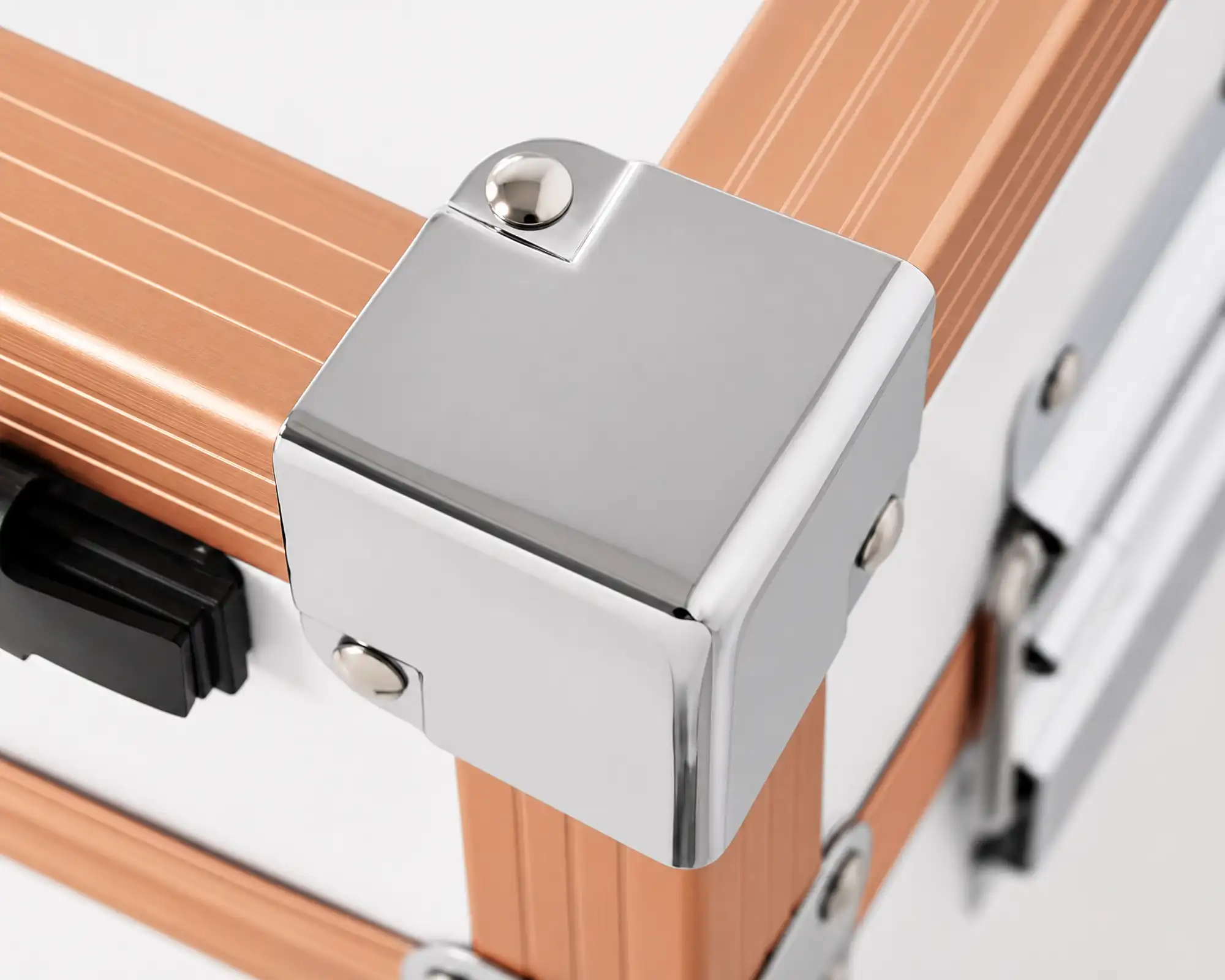 AL3829 uses an aluminum alloy frame for support. The tabletop, panels, and inner lining use HPL fire-retardant board. The storage box is made from aluminum alloy sheet material.
Each part does a different job. The frame gives the table strength, the panels help with surface durability, and the storage box makes the drawer area more solid.
Why HPL fire-retardant board works here
HPL fire-retardant board is a practical choice for a salon workstation. It handles daily contact, is easier to clean, and gives better short-term heat resistance than a plain wood-based surface.
It also fits the kind of use this table gets. Tools, products, cleaning liquids, and constant handling all put pressure on the surface.
How this structure helps daily work
The aluminum frame keeps the table steady. The HPL surfaces improve durability and cleaning performance. The aluminum storage box adds strength where drawers are used often.
That combination matters because a professional beauty table is used differently from ordinary furniture. It is moved more often, handled more often, and expected to keep working without trouble.
What the testing shows
The structure was tested under conditions that reflect real use.
| Test Item | Result |
|---|
| Acoustic output | ≤ 25 dB |
| Rolling endurance | 25,000 cycles |
| Static load limit | 35 kg per wheel |
| Bearing speed tolerance | 43,000 rpm |
| Particle shielding | Semi-enclosed housing |
| Obstacle impact | 500 crossings |
| Surface scratch resistance | 153 abrasion cycles |
| Instant impact resistance | 15 kg |
| Metal hinge durability | 5,000 cycles |
| Self-tapping screw torque | 3.39 N·m |
| Support structure loading | 4× rated load for 1 hour |
| Moving joint performance | 2.26 ± 0.56 N·m + 16 kg axial pull |
| Polymer thermal stability | 7 hours at elevated temperature |
These results matter because they show the table is built for repeated commercial use, not just display. The point is not only that it works once, but that it keeps working after long use.
Why the wheels matter
For a rolling manicure table, the wheels are part of the product’s core performance. Quiet movement matters in a salon. Load-bearing capacity matters when the table is carrying tools and products. Durable wheels also help the table last longer.
AL3829’s wheel system is tested for that kind of daily use, so it behaves more like a working tool than a lightweight piece of furniture.
Why this setup is better than a basic board-and-wood build
A basic board-and-wood structure may look fine at first, but it usually does not handle daily commercial use as well. The weak points tend to show up in the frame, the drawer area, the surface, or the moving parts.
AL3829 is built differently. The aluminum frame gives it rigidity, the HPL surfaces support cleaning and durability, and the aluminum storage box makes the structure feel more solid where it is used most.
What buyers usually care about
Buyers looking for a professional rolling manicure table usually care about three things: stability, safety, and lifespan. They want a table that moves well, feels solid, and does not become a maintenance issue too soon.
That is where this structure makes a difference. It is built for real salon work, not just for appearance.
Best use cases
AL3829 is a good fit for mobile nail services, salon stations, training rooms, and buyers who need a foldable manicure table that can handle regular use.
The real value is not the first impression. It is how the table holds up after repeated moving, loading, cleaning, and working.
FAQ
Conclusion
AL3829 is built for real work. The aluminum frame, HPL fire-retardant surfaces, and tested mobility parts all support stability, safety, and durability.
For a professional rolling manicure table, that is the kind of build that matters after the first week, not just on day one.
This article was prepared by the Obeautycase engineering team and reviewed by Alex Lee, Product Development Specialist, before publication.