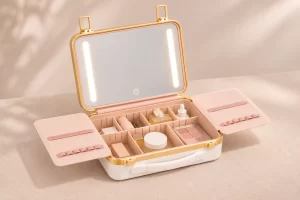
A case can match your product dimensions on paper and still fail on the packing table. The reason is usually structural: the internal space is not one open box, and the brush storage sits above the compartment rather than beside it.
That is the DX-12 cosmetic kit fit question — and it is answered by the internal structure, not by the outer dimensions.
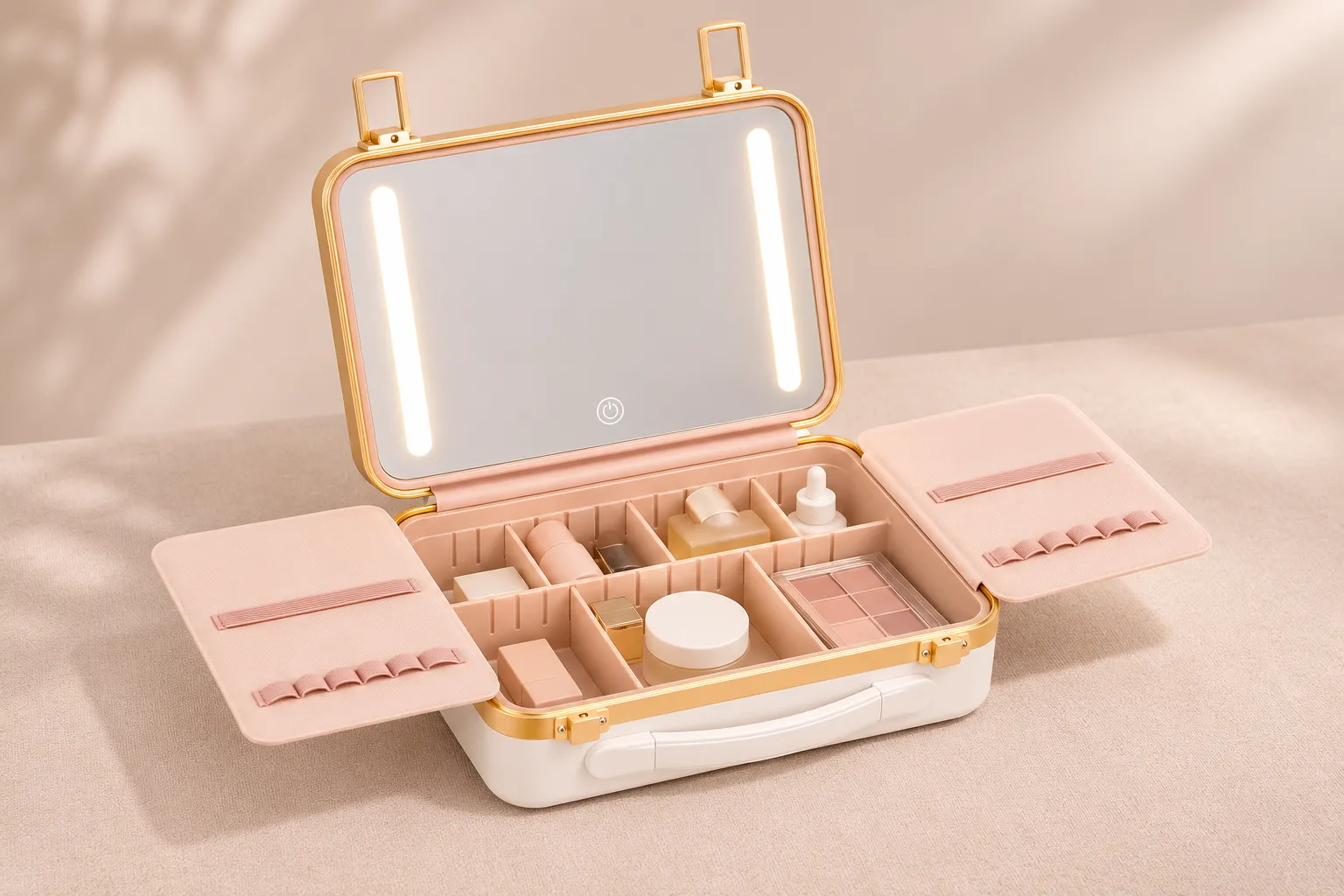
The DX-12 is a useful example because it has both features at once — one fixed transverse divider, five removable dividers, and two fold-out brush panels above the main compartment. This guide walks through the checks a buyer should run on a sample before approving a kit, in the order that problems actually appear.
Start with the Fixed Divider, Not Just the Overall Dimensions
The internal space measures 27 × 20 × 6 cm with all five removable dividers removed; the fixed transverse divider stays in place. That divider splits the floor into two zones, each running the full 27 cm length and measuring 6.5 cm and 12.5 cm wide — the remaining 1 cm is the thickness of the divider itself.
For a buyer, the practical consequence is this: a palette, a bottle or a tray that clears 27 cm in one direction may still not clear the zone it has to sit in.

Match the Removable Dividers to Your Product Assortment
Five dividers come out, and they are not identical: three are shorter pieces for one side, two are longer pieces for the other. Between them and the fixed divider, the interior can be split in several ways.
What the dividers do not do is create six equal compartments. Counting pieces is not a capacity measure — what matters is which pieces you keep in place for a given assortment.


Check Brush Fit Before Folding the Panels Back
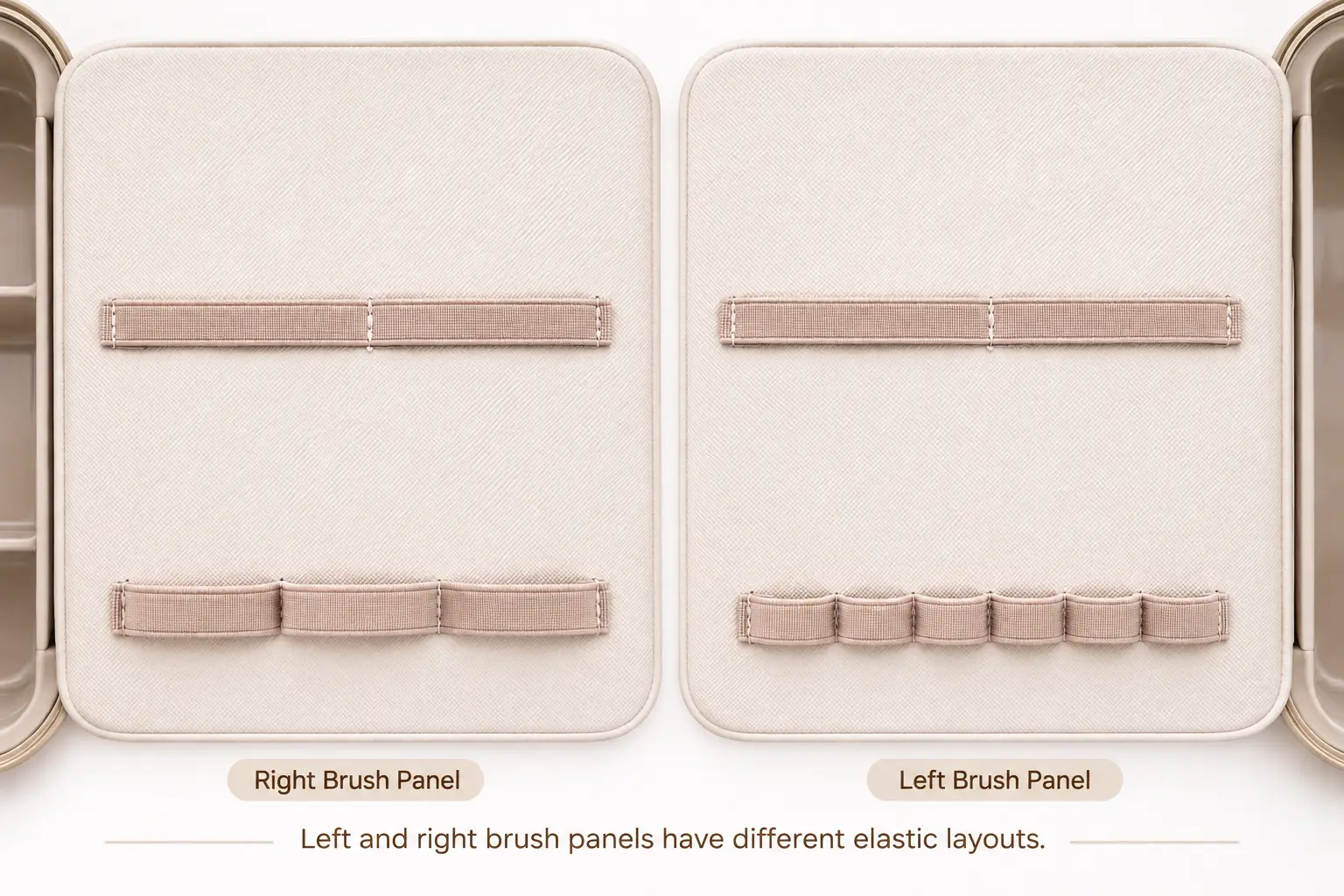
The two brush panels fold out from above the main compartment. Their elastic retaining sections differ:
- Left panel — two wider sections with six narrower sections below.
- Right panel — two wider sections with three medium-width sections below.
These are elastic retaining sections, not fixed slots. How many brushes one section holds depends on handle diameter and on how you group short and long brushes together — so a section count is not a brush capacity rating.
The check that catches problems is the return path, not the loading. Load the panels, then fold them back over the main compartment. Thick handles lift the panel away from the case body, and a panel that will not seat flat is a panel that will press against the mirror side when the lid closes. Brushes longer than the panel depth will protrude the same way.
Evaluate the Complete Packing and Closure Sequence
Individual checks do not catch interference between parts. Run the full sequence on your own assortment, in this order:
- Open the lid and fold out both brush panels.
- Install or remove the removable dividers for the assortment you are considering.
- Place the actual products and brushes from your kit — not substitutes.
- Fold the brush panels back over the main compartment.
- Close the lid and check for pressure, interference, or a lid that will not sit flush without force.

Three failures are worth naming, because they are easy to miss until production: the lid closing but pressing the mirror against loaded brushes; a panel that sits proud of the case body; and a divider that lifts when the lid closes because an item underneath is too tall.
This sequence is a procedure for your sample. It is not a claim that a specific assortment has been tested — the kit that matters is the one you intend to ship.
Include Mirror Setup and Charging Access in Sample Approval
Two details on this format are frequently misread, so they belong in the sample check rather than in the catalogue description:
- The mirror is fixed into the lid and does not detach. It cannot be removed and used as a standalone desk mirror. The lid opens on a metal resistance hinge to 180°, so the viewing angle is set by the lid position.
- Charging is USB-C at 5V input. The port sits under a protective cover. Confirm the cable in the box matches your market’s requirements, and confirm the port is reachable without removing the case contents.
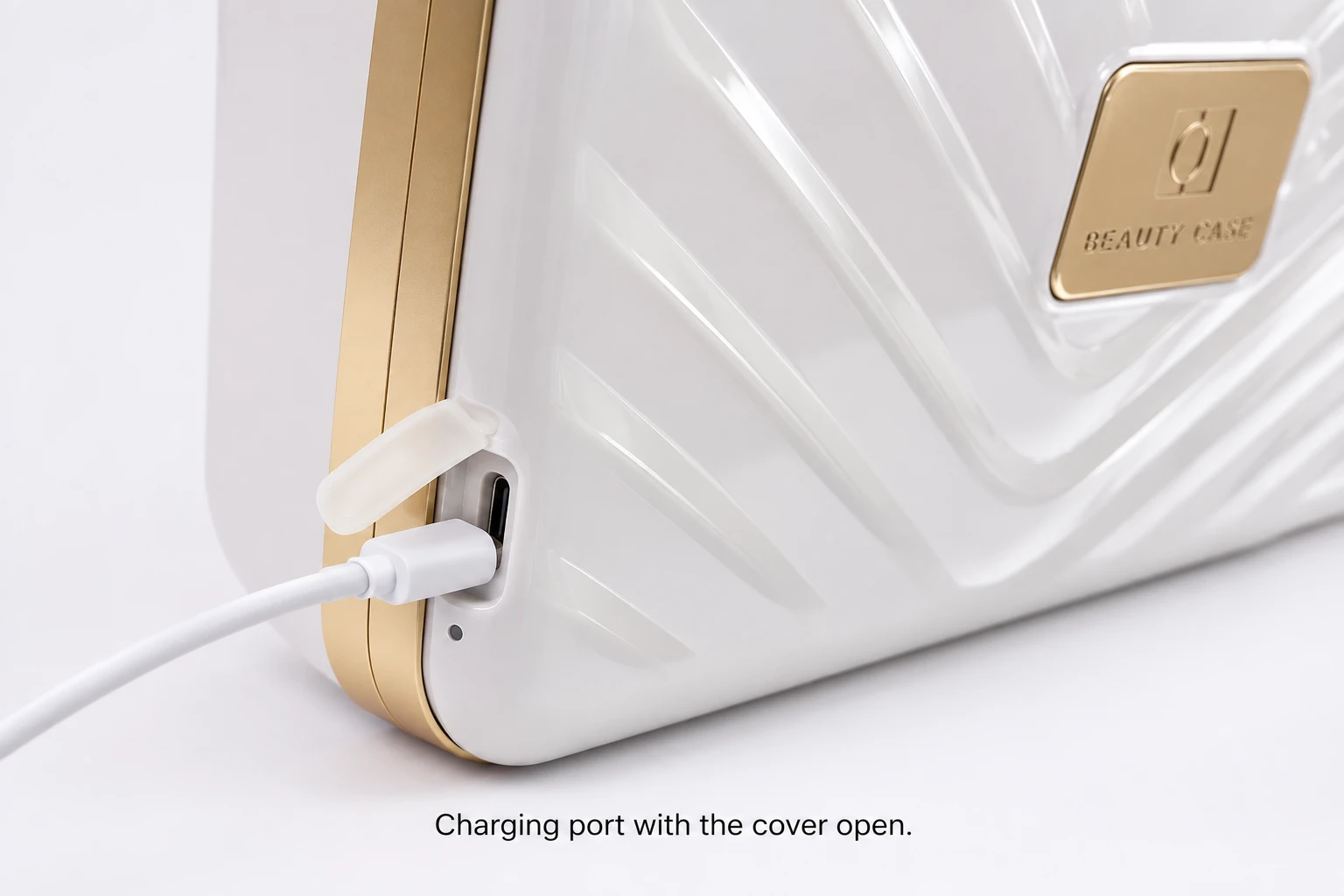
Lighting is controlled by a single touch button: tap to cycle warm, natural and cool modes, long-press to adjust brightness. The published runtime is up to 30 hours under normal-brightness conditions; brightness level and selected mode change that figure, so it is worth confirming actual behaviour in the dim room your customer will use it in rather than relying on the headline number.
What to Send Your Supplier Before Approving the Kit
Each of the checks above produces information your supplier needs. Sending it up front removes most of the back-and-forth that follows a first sample:
- Product dimensions and outer packaging dimensions for each item in the kit.
- Brush lengths and handle diameters, grouped by how you intend to store them.
- The divider layout you want to keep, and which removable pieces you would drop.
- The result of your own closure and interference check — including anything that did not fit.
- Colour, logo method and packaging requirements, since these affect tooling and lead time.
Different divider systems suit different kits — browse the other OEM makeup bags in the range.
For the full configuration, measurements and available colours, see DX-12 specifications and configuration.
The DX-12 is available in nine colours with an MOQ of 500 units.
A kit that fits is not the same as a case that matches a number. The fixed divider, the removable pieces and the brush panels each decide something different — check them in that order and the closure test at the end will tell you what the catalogue cannot.