Most folding makeup chair descriptions start with the seat. Fabric, colour, padding, stitching. Those are the parts a buyer can see in a photo, so they are the parts that get written about.
The frame is usually what decides whether the chair is still usable in year three. On a folding chair, that means the X.
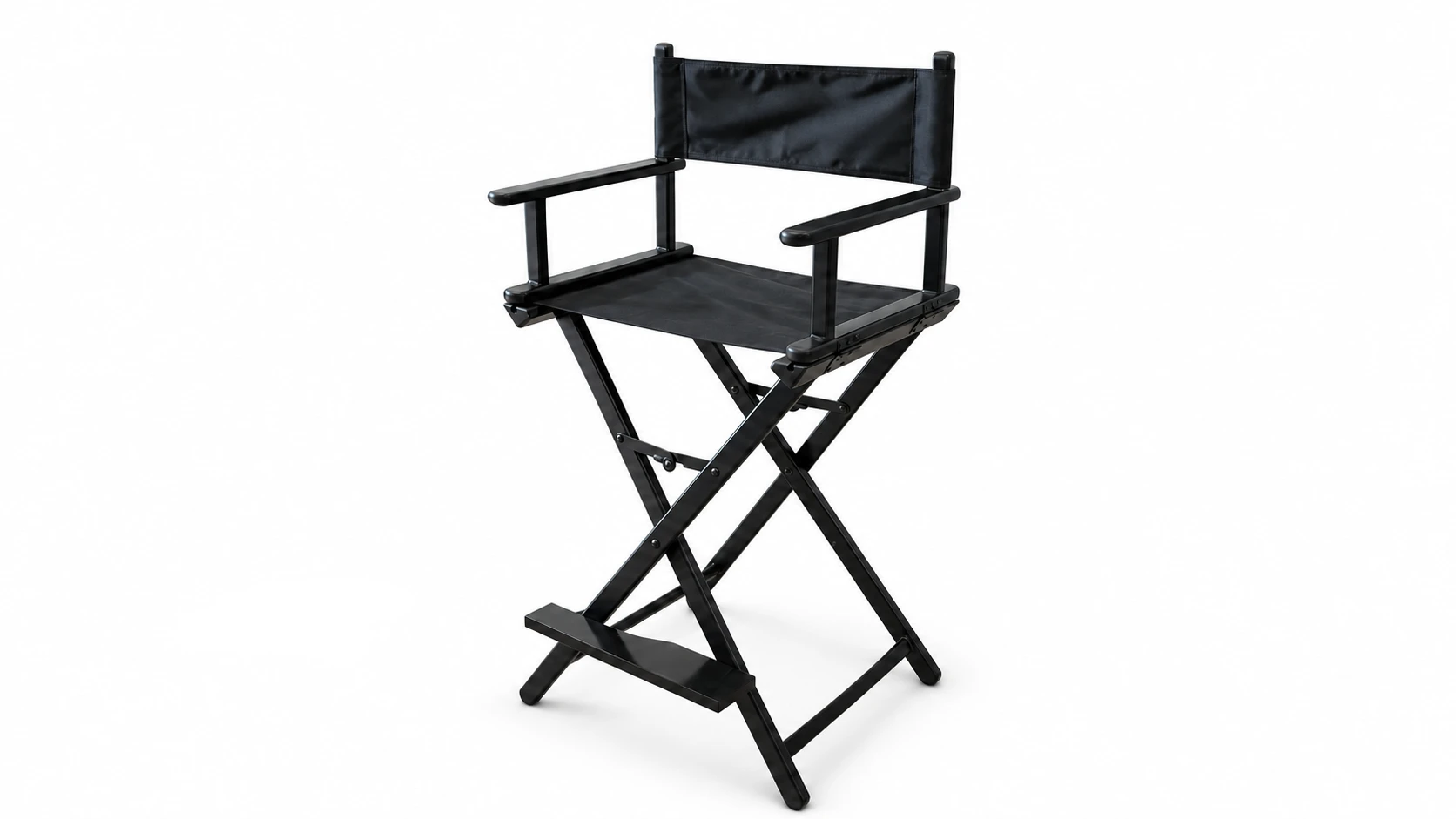
The X is a folding mechanism, not a design detail
A fixed chair can stand on four legs because the legs do not have to move. A folding chair has to collapse into something narrow enough to carry, and it has to do that without bolts being removed each time.
That is what the X does. Two frame members cross at a pivot, which lets the chair fold for transport. When the chair is open, the frame and its connections carry the load from the seat. Closing it is one movement, and nothing has to be taken apart.
That is why every folding makeup chair in this range uses the same geometry, whether it carries a headrest, a tool tray or neither. MY, MYT and DMY-Chair are different configurations of one structural idea.
Where the load actually goes
Sitting down puts force on the seat. The seat transfers it to the frame at the two side rails, and the side rails push it into the crossing members.
In simplified terms, the load reaches the floor through four points rather than one column under the seat. The exact distribution depends on the frame geometry, but the principle is what matters when you look at a sample.
On MY, MYT and DMY-Chair, the seat height and frame height are fixed. The MYT headrest is removable and vertically adjustable. A chair with height adjustment is a different structure with a different set of parts to check, so the two should not be read as one being a better version of the other.
The hinge is the part that wears
Every setup and every teardown is a cycle, and the pivot records them. A chair used five days a week, twice a day, sees about five hundred open-and-close cycles in a year. A chair that travels between clients can see more.
The pivot takes that load in a small area, which makes it the first place to check on a sample. Open and close the chair several times. Check the pivot for unusual noise, excessive play or binding, and agree the acceptance criteria with the supplier before ordering.
Wear shows up in three ways. The pivot loosens and the chair rocks slightly when open. The rivet or bolt develops play. The frame members start to bind at the crossing point, which can come from deformation, from wear, or simply from grit in the joint.
None of this is visible in a product photograph. It is visible in a sample, in about two minutes.
Frame material and finished weight
This range uses an aluminium-alloy frame. The confirmed net weights are 4.15 kg for MY, 5.9 kg for MYT and 5.8 kg for DMY-Chair. Alongside the weight, each model carries its own configuration: MY has fixed armrests and an integrated front footrest, MYT has a removable headrest, and DMY-Chair has a perforated folding tool tray.
Material and finished weight are two figures a buyer can compare directly across models, and if the chair will be carried between appointments they matter more than the upholstery. How the three configurations are chosen is covered in the configuration guide.
What this means when you specify
| Check | What you are looking for |
|---|---|
| Pivot | Riveted, bolted or pressed pin; no play when the chair is open |
| Stop | Frame does not over-open under load |
| Weight | Matches the carrying routine, not just the spec sheet |
Ask how the pivot is fixed: riveted, bolted or a pressed pin. Ask whether the frame has a stop that prevents over-opening. Then check the finished weight against how often the chair will be moved and by whom.
Finally, ask for a sample and open it twenty times. The chair will tell you more in that minute than a specification table will in a page.
Seat, fabric and colour can be discussed and confirmed per project. If you are comparing the three models, the difference between them is configuration rather than frame, so the frame check applies to all three the same way.