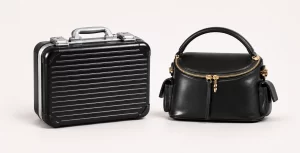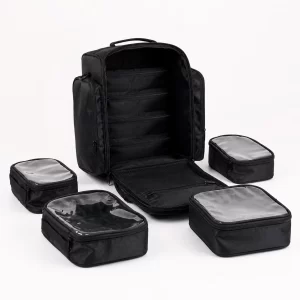
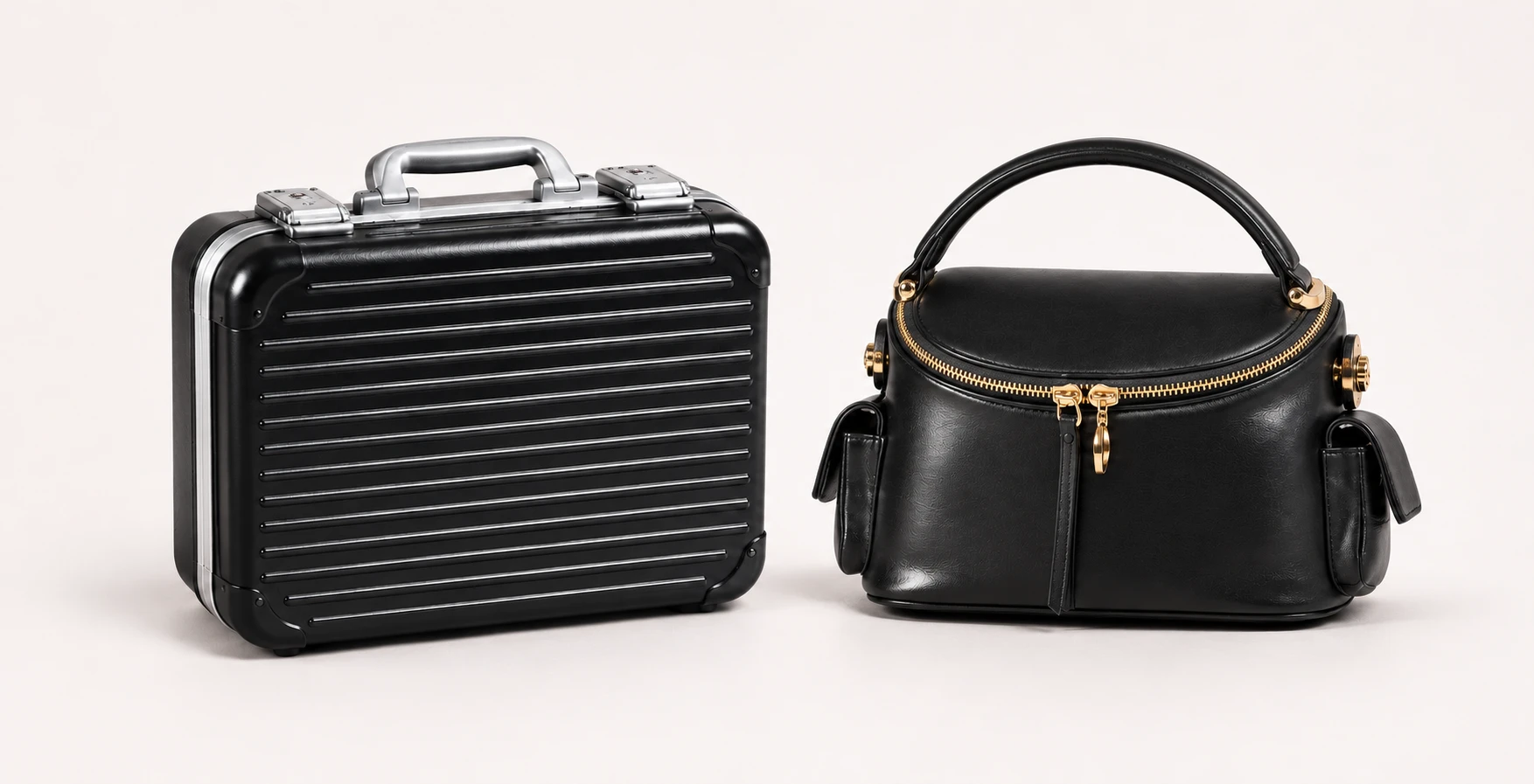
Two cases can hold exactly the same kit and behave nothing alike. One takes a hit and passes it to the contents. The other absorbs the hit and gives up a little shape each time. Buyers usually describe this as “hard versus soft”, but the useful distinction is narrower: what the shell is made of, and what it does when it is dropped, packed or repaired.
This is what the two constructions actually are. Buyers searching for a hard makeup case and buyers searching for a soft makeup case usually carry the same kit and work under different constraints, so the comparison below uses four hard cases and one soft bag from our own range.
What a hard makeup case is
Three constructions get called a hard shell makeup case, and they fail in different places.
A moulded PC shell over an aluminum frame. The 4029 uses this: a polycarbonate shell around an aluminum alloy frame, a zinc alloy hinge, an EVA interior with repositionable foam dividers, and a three-digit password lock with a custom brand plate. It weighs about 2 kg and measures roughly 40 × 29 × 16 cm. The frame is what keeps the case from twisting; the PC shell is what takes impact. The 4029A is the same idea at a larger size — 3 kg, a detachable rechargeable mirror with 72 LED beads at Ra95, a 3000 mAh battery and Type-C charging.
A one-piece formed aluminum shell. The JCW-AL is formed as a single aluminum shell rather than assembled from panels. There is no frame-to-shell joint to work loose, the hinges are M-shaped metal, the lining is flocked over 3 mm EVA, and the lock is a TSA007 combination or a keyed buckle depending on configuration. This is the most rigid construction in the range, and the least forgiving when a corner takes a direct hit.
An aluminum box with reinforced corners. The 2522 weighs 1.25 kg at 240 × 178 × 240 mm, with metal corner protectors, a lockable metal buckle and a top carry handle. It is a toolbox in the traditional sense — the corners take the abuse so the panels do not.
What a soft makeup case is
Soft is not one thing either. A structured bag holds its shape on its own; an unstructured one collapses into whatever is inside it.
The YMB is the structured kind: oil-wax PU leather in Black and Brown, washed denim in Blue, a curved bucket silhouette with two raised side flap pockets and snap closures, a metal two-way zipper, and a fixed raised handle for hand, elbow or shoulder carry. At 250 mm long and 320 mm high including the handle, it stands up on a counter between jobs. There is no mirror and no rigid insert — the structure comes from the material and the pattern, not from a frame.
That distinction matters more than the fabric. A structured soft bag keeps contents away from dust and casual handling; an unstructured pouch mostly keeps them together.
The four trade-offs
Protection. A hard case transfers impact to the shell and then to the EVA lining. A soft bag absorbs impact but passes some of it through. For glass bottles, pressed powders and anything with a mirror, the hard case wins. For brushes, textiles and refill packs, the soft bag is sufficient and lighter.
Weight. The 4029 is 2 kg empty and the 4029A is 3 kg; the YMB carries a full artist kit at a fraction of that. On a mobile artist who moves between four appointments a day, two kilograms of empty case is a real cost.
Repairability. A PC shell that cracks is normally replaced rather than repaired. A soft bag can usually be re-stitched, have a zip replaced or a snap re-set. For markets where returns are expensive, that difference decides the warranty model.
Packing. Hard cases stack and often carry a rear trolley strap for luggage. Soft bags compress, which matters when the case travels inside another bag or ships as an accessory rather than as the main product.
Compare the five side by side
| Model | Construction | Empty weight | Interior | Closure | Best for |
|---|---|---|---|---|---|
| 4029 | PC shell + aluminum frame | About 2 kg | EVA with foam dividers | 3-digit password lock | Artists who need a mirror and a lock |
| 4029A | PC shell + aluminum frame, larger | 3 kg | EVA, detachable LED mirror | 3-digit combination lock | Salon and training use with a rechargeable mirror |
| JCW-AL | One-piece formed aluminum | Not published | Flocked over 3 mm EVA | TSA007 or keyed buckle | Equipment and instruments that must not move |
| 2522 | Aluminum box, reinforced corners | 1.25 kg | Dual-layer divided storage | Lockable metal buckle | Tools, refills and smaller kits |
| YMB | Structured oil-wax PU or denim | Not published | Elastic pockets, no insert | Metal two-way zipper | Retail-facing bags that must look like fashion |
One column is deliberately incomplete: we have not published empty weight for the JCW-AL and the YMB, and we are not going to invent it. If weight is a deciding factor for your project, ask for it against the exact configuration, because handle type and lining change it.
Which buyers choose which
Brands building a retail kit tend toward soft. The YMB is a bag a customer carries as a bag, and the cost structure supports a lower retail price. The shell decision is a design decision, not a protection decision.
Artists and mobile teams tend toward the 4029 family: a mirror in the lid, a lock, and a shell that survives being loaded into a van four times a day.
Salons, academies and chains tend toward the 4029A or a rolling case, because the mirror is used at the station rather than carried.
Anyone shipping instruments, lenses or precision tools tends toward the JCW-AL. The one-piece shell and the flocked EVA exist to stop movement, not to look good.
What to specify before quoting
Five lines decide the quote more than the price does:
- Shell construction — moulded PC over a frame, one-piece aluminum, aluminum box, or soft with a structured pattern.
- Interior — EVA with repositionable dividers, flocked over EVA, elastic pockets, or nothing.
- Closure — password lock, TSA combination, keyed buckle, or a two-way zipper.
- Empty weight target, plus whether the case must fit inside another bag.
- Whether a mirror is required, and if so whether it must be detachable and rechargeable.
Our standard MOQ across these lines is 500 units, with sampling at about 15 days and bulk production at 25 to 35 days after sample approval. The sample approval checklist covers what to verify on the physical unit, and the materials guide covers shell and lining comparisons in more depth.
Where to go next
- See the full hard-case range on the makeup boxes category page and the trolley case category.
- Compare the two PC-shell models: 4029 and 4029A.
- Look at the one-piece aluminum construction on the JCW-AL.
- See the soft reference on the YMB shoulder bag.
- If the construction question is really about interior layout, the divider and compartment guide goes deeper on pouches, slots and zips.
Need Help Choosing Between Hard and Soft?
Send the kit, the packing method and your target market. We will come back with a construction, MOQ and lead time. Contact our team with whatever specification you already have.